
There is a particular kind of stubbornness to knee pain. It does not announce itself dramatically. It arrives as a mild protest on the stairs one morning, a reluctance to bend after a long car ride, a stiffness that needs ten minutes of walking to warm out of the joint. Most people negotiate with it for months, sometimes years, before they begin to take it seriously.
By the time they do, the knee has usually been trying to communicate something for a long time.
Ayurveda's most important contribution to understanding knee pain is not a remedy. It is a reframe. The knee does not hurt in isolation. It hurts because something upstream has been out of balance, poor circulation, weakened digestion, accumulated toxins, a Vata dosha that has been aggravated by irregular routine, prolonged sitting, cold exposure, or chronic stress, and the joint has become the most visible site of a systemic problem. Address the knee alone and the relief is temporary. Address what produced the knee pain and the body begins to change.
This is the philosophy behind the knee pain treatment approach at SOUKYA, Dr. Mathai's International Holistic Health Centre in Whitefield, Bangalore, India's first NABH-accredited AYUSH Hospital for Ayurveda, Homeopathy, Yoga and Naturopathy.
The knee is one of the most mechanically complex joints in the body and one of the most vulnerable to Vata imbalance. In Ayurvedic understanding, Vata governs movement, flexibility, and the neuromuscular activity of the joints. When Vata is aggravated, whether by years of overuse, a sedentary lifestyle, nutritional gaps, or the natural process of aging, joints begin to lose their cushioning. The synovial fluid that keeps the joint surfaces gliding smoothly against each other diminishes. Tissues dry out. Cartilage wears. Muscles that were once strong enough to support the joint become stiff and unreliable.
This is not a sudden event. It is the accumulated result of a body that has been asked to keep pace without being given the support it needed to do so. According to Ayurveda, most orthopaedic conditions, including chronic knee pain, are the delayed consequence of this gradual withdrawal of care, from diet, from movement, from rest, from the small daily practices that keep the body's systems functioning in harmony.
Understanding this is what separates knee pain treatment in Ayurveda from simply managing symptoms. The goal is not to suppress the pain signal. It is to restore the conditions under which the knee can actually heal.
Before any treatment begins, it helps to understand what is actually happening inside a painful knee. The joint depends on several things working together: healthy cartilage to absorb impact, adequate synovial fluid to reduce friction, strong surrounding muscles to distribute load, and unobstructed circulation to deliver nutrients.
When any of these fail, the others compensate until they cannot. Cartilage thins. The joint space narrows. Bone begins to contact bone. Inflammation follows, and with it, the swelling, warmth, and pain that make even ordinary movement a negotiation.
Ayurvedic treatment for joint pain addresses each of these layers, not sequentially but simultaneously, because the body does not heal in neat, isolated steps.
At SOUKYA, orthopaedic treatment begins where most treatments do not: with a conversation about the whole person. A comprehensive evaluation gathers information about the individual's constitution, lifestyle, digestion, stress levels, sleep patterns, and the history of the condition before a single therapy is prescribed. Ayurvedic diagnosis is integrated with contemporary medical assessment, including imaging and investigations where relevant, to ensure both safety and clinical accuracy. From this, a treatment protocol is designed that is specific to the person, not to the diagnosis alone.
Treatment strategies are adapted as the body responds rather than following a fixed protocol. This dynamic approach, as SOUKYA describes it, makes all the difference between continued progress and stagnation.
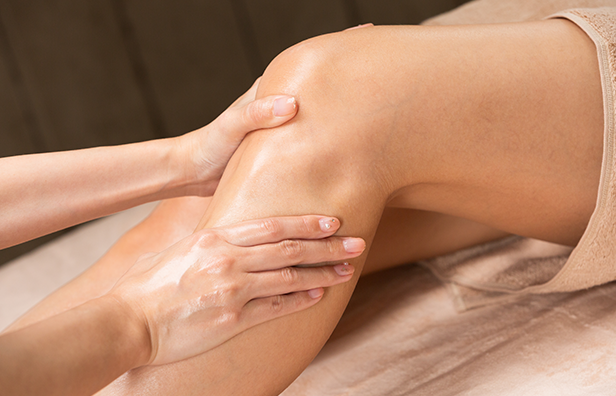
The first and most fundamental external treatment for knee pain in Ayurveda is Abhyanga, a medicated oil massage using oils chosen specifically for the individual's constitution and condition. This is not a relaxation massage. The oils are selected by a physician for their therapeutic properties and are applied with pressure and technique designed to penetrate deeply into the tissues, improving circulation, reducing the dryness that aggravates Vata-driven joint pain, and relieving the muscle tension that builds around a painful joint as the surrounding muscles try to protect it.
Many people recall oil massages from childhood as something that was done without question, a daily or weekly ritual that kept the body supple and well. Ayurveda formalises that intuition into a precision treatment, where the choice of oil, the direction of strokes, the temperature, and the pressure are all determined by the clinical picture.
At SOUKYA, Abhyanga is delivered by trained therapists under physician supervision, ensuring the oils used and the technique applied are genuinely therapeutic rather than generic.
Heat has always been instinctively understood as a friend to stiff, painful joints. Ayurveda's version of this is Swedana, or herbal steam therapy, which is typically employed after Abhyanga. The steam relaxes muscles, increases flexibility, and deepens the penetration of the medicinal oils into the tissue. It also helps loosen ama, the accumulated metabolic toxins that settle in joints and surrounding tissue, creating the inflammatory environment that sustains chronic pain.
For knee pain specifically, the combination of Abhyanga followed by Swedana creates a therapeutic sequence that works from the surface of the tissue inward, softening what has hardened and opening the channels through which nutrients and circulation need to flow.
For chronic or degenerative knee conditions, where the problem runs deeper than surface inflammation or muscle tension, Vasti or medicated enema therapy is considered one of Ayurveda's most powerful interventions. It may seem counterintuitive that a treatment administered through the colon would affect the knee, but Ayurveda's understanding of the body as an interconnected system makes this entirely logical. Vasti addresses Vata at its seat, in the large intestine, from where Vata's influence extends throughout the body including to the joints. By restoring Vata balance systemically rather than locally, Vasti addresses the root of the imbalance that knee-focused treatments alone cannot fully reach.
SOUKYA's orthopaedic page confirms that in more chronic or degenerative cases, Vasti may be indicated precisely because it is systemic rather than local.
External treatments create the conditions for healing. Internal herbal remedies do the building work. At SOUKYA, internal herbal formulations are prescribed to support bone health, muscle health, reduce inflammation, and regulate metabolism. These are not generic supplements selected from a standard protocol. They are individually prescribed based on each person's constitution, the specific nature of their knee condition, and their overall metabolic and digestive profile.
This matters because Ayurvedic medicine places digestion at the centre of tissue health. Bones and muscles are sustained by what the body can actually absorb and utilise, not simply by what is consumed. A person with weakened digestive fire will not repair tissue effectively regardless of what they eat. Internal herbal remedies work both on the tissue directly and on the digestive capacity needed to sustain the repair.
One of the most common errors people make with knee pain is to stop moving entirely. Rest feels protective. But in Ayurveda's understanding, and increasingly in modern orthopaedic thinking as well, prolonged immobility compounds the problem. Circulation to the joint decreases. Surrounding muscles weaken further. The joint's supporting structures become less capable of sharing the load.
At SOUKYA, movement is not avoided. It is reintroduced slowly and carefully. Exercises for knee pain in the Ayurvedic therapeutic framework focus on alignment, balance, and gentle, progressive loading rather than pushing past pain. Yoga asanas are taught with the specific goal of decreasing joint stiffness and increasing mobility without aggravating inflammation. Pranayama and breathing techniques support the nervous system regulation that helps break the pain-tension cycle many people with chronic knee pain are caught in. Meditation offers a way of changing the relationship with the pain itself, which research consistently shows has a meaningful effect on how pain is experienced.
As SOUKYA's approach describes it, as circulation increases and inflammation decreases, confidence in movement often comes back on its own. What was once done cautiously starts to feel normal again.
No Ayurvedic programme for knee pain treatment is complete without addressing diet, because the joint is ultimately a product of what the body receives and can use. Warm, cooked foods with adequate healthy fats are favoured because they sustain joint fluid and muscle flexibility. Spices that support digestion and reduce inflammation are incorporated not as supplements but as daily kitchen practice. Processed foods, irregular eating habits, and a dry diet are avoided because they deplete the body's capacity to repair tissue under stress.
At SOUKYA, this is not advice handed out on a sheet. It is a living part of the programme. Meals are freshly prepared from the centre's own 30-acre organic farm, and every guest receives a nutritional assessment with individualised dietary guidance built into their treatment plan.
Orthopaedic problems are not interchangeable. A knee that hurts because of decades of marathon running needs a different approach than a knee that hurts because of inflammatory arthritis, or one that aches from years of sedentary work and weight gain. Age, lifestyle, digestion, the duration and pattern of symptoms, and the individual's constitution all influence how healing unfolds and what it requires.
This is why a visit to SOUKYA is not the same as a course of standard treatment. It begins with understanding who the person is before designing what they need. The treatment is monitored daily and adjusted as the body responds. And when the stay ends, it does not simply stop: medicines can be prescribed for home use, follow-up care is actively encouraged, and the dietary and lifestyle guidance given during the programme is designed to be continued in daily life.
For those who have been managing knee pain for months or years with pain relief medication and periodic flare-ups, this depth of care often represents a genuine shift. Not a quick fix, but a different kind of relationship with the body, one in which the knee finally gets the conditions it needs to stop compensating and start healing.
1. What is the Ayurvedic approach to knee pain treatment?
Ayurveda approaches knee pain treatment by identifying the underlying doshic imbalance, typically Vata aggravation, that is driving the joint's deterioration, and addressing it through a combination of external therapies, internal herbal medicines, Yoga, and dietary support. At SOUKYA, this is delivered as a personalised, medically supervised programme that integrates Ayurveda with Homeopathy, Naturopathy, and Yoga for a comprehensive approach to joint health.
2. Which Ayurvedic therapies does SOUKYA use for knee pain?
SOUKYA's orthopaedic treatment for knee pain draws on Abhyanga (medicated oil massage), Swedana (herbal steam therapy), Vasti (medicated enema therapy for deep Vata imbalances), and internal herbal remedies to support bone health, muscle strength, and reduce inflammation. All therapies are individually prescribed following a comprehensive evaluation.
3. Are exercises for knee pain part of SOUKYA's treatment?
Yes. Yoga and therapeutic movement are an integral part of the programme at SOUKYA. Exercises for knee pain at SOUKYA are taught with a focus on alignment, balance, and gentle progressive movement, not pushing through pain. Asanas are selected specifically to reduce stiffness and improve mobility, while pranayama and meditation support the nervous system and the body's overall response to pain.
4. How is knee pain treatment at SOUKYA different from physiotherapy or conventional orthopaedic care?
SOUKYA's approach integrates Ayurvedic therapies, internal herbal medicines, Yoga, Naturopathy, and Homeopathy within a medically supervised, individually designed programme. Ayurvedic diagnosis is combined with contemporary medical assessment, including imaging where needed, and treatment is adjusted daily as the body responds. Orthopaedic and rheumatology specialists are brought in where required, making this a genuinely integrative approach rather than an either-or choice.
5. How long does it take to see results from Ayurvedic knee pain treatment?
This depends on the nature and duration of the condition, the individual's constitution, and how consistently the programme is followed. At SOUKYA, treatment strategies are adapted as the body responds rather than fixed to a predetermined timeline. Guests are encouraged to continue their treatment through home medicines, dietary practices, and follow-up consultations after leaving the centre, as lasting results in orthopaedic conditions develop progressively rather than all at once.
Address:
SOUKYA International
Holistic Health Centre,
Soukya Road, Samethanahalli,
Whitefield, Bangalore - 560067 India.
Phone: +91 80 2801 7000 - 08
Phone: +91 98453 74400
Whatsapp: +91 96862 01760
Email: booking@soukya.com
Copyright © 2001 SOUKYA. All rights reserved. | Privacy Policy

