
Cancer changes a person. Not just physically, but in other ways that are harder to name. The treatment ends, the scans are clear, the world waits for a return to normal. But the body that leaves the oncology ward is not the body that entered. The fatigue that lasts for months. The appetite that doesn't come back the way it used to. The anxiety that hits you out of nowhere, on a normal Tuesday. The numbness. The swinging weight. The sleep that won't settle. These are not side effects of the medicine. They are the territory cancer rehabilitation was supposed to traverse.
And for a lot of people, this is where the real work starts.
In medicine, recovery from cancer is defined mostly as being free of disease. But the lived experience of recovery is something more complex and profound than a clean scan. It's a re-education of a relationship to a body that's been through something profound. And in the matter of getting back energy and confidence and the simple ability to get through a day without exhaustion as a constant companion.
Cancer rehabilitation fills that gap. It is the area of care not for fighting cancer, but for what follows the fight or runs alongside it. It encompasses supportive care during active treatment to manage side effects and maintain quality of life, and palliative care that prioritises comfort, dignity and wellbeing when cure is not the primary aim.
Supportive and Palliative Cancer care is a part of the Medical Programme of SOUKYA, Dr. Mathai's International Holistic Health Centre, Whitefield, Bangalore. SOUKYA is the first NABH accredited AYUSH Hospital in India for Ayurveda, Homeopathy, Yoga and Naturopathy. Cancer rehabilitation at SOUKYA is not an ancillary service; it is serious integrative medical care for guests from over a hundred countries who come to SOUKYA looking for something that, for all its brilliance, conventional oncology was never designed to provide.
While these two terms are frequently used interchangeably, they actually refer to different stages and purposes of cancer care.
Supportive care with active cancer treatment. Its purpose is to ease the burden of treatment itself, addressing the nausea, fatigue, pain, immune suppression, emotional distress and nutritional depletion chemotherapy, radiation and surgery can cause. People on supportive care are still fighting the disease. What supportive care does is make that fight more survivable, preserving quality of life and the body's own resilience throughout the process.
Palliative care, by contrast, is not about fighting the disease. It's about the person. When cure is no longer the goal, palliative care focuses entirely on comfort, dignity, symptom relief, emotional support, and the preservation of as much quality of life as possible for as long as possible. This is care in the fullest meaning of the word.
Both types are included in the cancer rehabilitation at SOUKYA, which is part of the Medical Programme and is personalized for each individual.
Before any programme can be designed it helps to understand what conventional cancer treatment leaves behind. The body is not a passive recipient of treatment. It's an active player and aggressive treatments like chemo and radiation hit not just the cancer cells they are aimed at, but a wide variety of systems all at once.
Immune function is often impaired, leaving the body vulnerable and slow to regain its natural defences. Digestive health is affected, with nausea, loss of appetite and changes to gut function being some of the most common side effects. Fatigue from cancer treatment is a specific clinical phenomenon, different from normal tiredness, and can continue for months or years after treatment is over. Impacts mental and emotional health in a profound way. Cancer survivors may suffer from depression, anxiety, grief and post-traumatic stress, but these are rarely treated with the same medical attention as physical symptoms. There is sleep disturbance. Body weight and composition changes. The nervous system is involved. The liver, kidneys and other organs carry the rest of the burden of processing potent pharmacological agents.
This is not a list of grievances. It's a map of what needs support, and it's exactly what SOUKYA's integrative approach is designed to address.
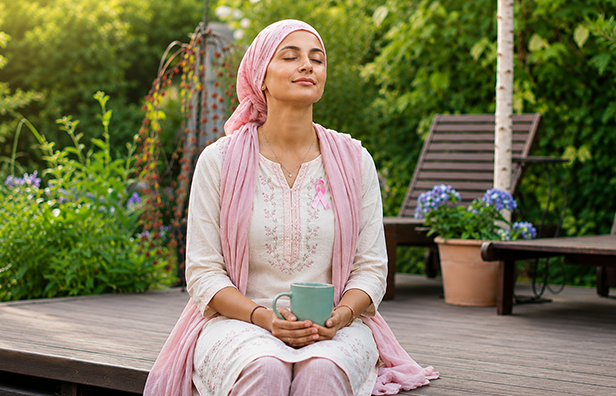
Every individual who comes to SOUKYA for cancer rehabilitation starts from the same point – a holistic health assessment. No treatment is prescribed without considering the patient's medical history, physical examination, current medications, active or completed treatment, emotional state and lifestyle factors. The protocol is then designed by doctors who are qualified and experienced in their respective systems of medicine, reviewed in a joint consultation, and monitored and adjusted daily as the body responds.
What follows is not a single modality applied repeatedly. It is a conversation between four systems of medicine, each offering something the others cannot.
Ayurveda brings its five-thousand-year understanding of the body's constitution and its capacity for restoration. Its treatments maintain health in the healthy and work to restore it in those who have been ill. For someone recovering from cancer treatment, the Ayurvedic focus on detoxification, rebuilding agni (digestive fire), strengthening immunity, and restoring the body's innate harmony offers a layer of cellular and systemic support that directly addresses many of the residual burdens of treatment. Ayurveda also guides on physical, mental, and social wellbeing, and aids in detoxification, de-stress, and relaxation, which for a cancer survivor is not a luxury but a medical necessity.
Homeopathy contributes constitutional care at a depth that larger pharmacological approaches cannot reach. For cancer care specifically, Homeopathy's documented effectiveness in autoimmune and chronic conditions, its ability to boost resistance, and the fact that its medicines are non-toxic and carry no risk of interference with other medications makes it a particularly safe and valuable partner for people who have already been through aggressive treatment regimens. One constitutional remedy is prescribed, addressing the whole person rather than isolated symptoms.
Naturopathy works through nature's five elements and the core principle that the body heals itself when toxins are removed and natural balance is restored. Mud therapy, hydrotherapy (including baths, compresses, colonic irrigations, and immersions), breathing exercises, outdoor walking on SOUKYA's 30-acre organic farm, sun therapy, and fasting therapy (where appropriate and medically supervised) collectively support detoxification, immune function, nervous system regulation, and the restoration of energy that cancer treatment so often depletes.
Yoga meets the person where they are. It does not demand performance. For someone in rehabilitation, the therapeutic use of asanas, pranayama, kriyas, meditation, and Yoga Nidra offers something irreplaceable: a way back into the body. A gentle, guided process of rebuilding physical strength and flexibility, improving respiratory function and heart rate regulation, and perhaps most critically for cancer survivors, creating a deeper coordination between mind and body that the experience of serious illness can shatter. Yoga is helpful in preventing and treating psychosomatic disease, and the psychological dimensions of cancer survival, the grief, fear, and identity disruption, are among the most significant.
Woven through all of this is nutrition. SOUKYA's kitchen is not a facility. It is part of the treatment. Freshly harvested from the centre's own organic farm, the ovo-vegetarian meals are designed to nourish at a cellular level. The organic produce, low-fat preparation, and therapeutic juices from the farm's herbs and seasonal harvest are not background features. They are medicine in the most ancient sense of the word.
SOUKYA's research, conducted in association with the London-based Thrombosis Research Institute, tested the biochemical changes produced by integrative treatment across forty individuals before and after treatment. Results showed that pro-inflammatory markers were significantly lowered, immune markers that diminish with age and stress were restored to normal levels, and coagulation factors associated with cardiovascular risk were reduced. All biomarkers improved considerably across even a minimal ten-day programme.
For people navigating cancer rehabilitation, where inflammation, immune suppression, and systemic stress are among the central clinical challenges, these findings are not incidental. They describe, in measurable terms, the kind of internal shift that explains why guests from over a hundred countries have returned to SOUKYA year after year for care that goes beyond what a clinic can offer.
This matters, and it is worth stating plainly. SOUKYA's Supportive and Palliative Cancer care programme is not a cancer cure. It does not replace oncology, chemotherapy, radiation, or surgery. It does not make claims about treating the disease itself. What it offers is something different and complementary: the restoration of the person around the disease, and after it. The strengthening of a body that has been through something difficult. The steadying of a mind that has been through something harder. And the creation of conditions in which genuine healing, in the fullest sense of that word, becomes possible.
For a guest from Trinidad who described SOUKYA as "a blissfully wonderful sanctuary," or for Dr. Jobst from the UK who called his experience there "life changing and lifesaving," the value was not in a single treatment. It was in a place and a team that had the skill, the systems, and the intention to care for the whole human being.
That is what cancer rehabilitation at its best looks like.
1. What is cancer rehabilitation and who is it for?
Cancer rehabilitation is supportive and palliative care designed to manage the physical, emotional, and systemic effects of cancer and its treatment. It is for people currently undergoing treatment who need support through the process, for survivors managing long-term side effects, and for those in palliative care whose focus is quality of life and comfort rather than cure. At SOUKYA, this programme is available as part of the Medical Programme and is individually designed for each guest.
2. What kind of cancer care does SOUKYA offer?
SOUKYA's cancer care programme falls under Supportive and Palliative Cancer Care within its Medical Programme. It uses an integrative framework of Ayurveda, Homeopathy, Naturopathy, and Yoga, individually designed and daily-reviewed by a team of qualified physicians. SOUKYA does not treat cancer itself but supports the person through and after treatment, addressing immunity, energy, emotional health, nutrition, detoxification, and overall quality of life.
3. Can SOUKYA's integrative approach be used alongside conventional cancer treatment?
Yes. SOUKYA's integrative framework is designed to complement, not replace, conventional oncological care. Homeopathic medicines used at SOUKYA carry no risk of side effects or interference with other medications. Ayurvedic and Naturopathic treatments are prescribed by qualified physicians who are fully informed of each guest's treatment history and current medications before any protocol is designed.
4. How is a cancer rehabilitation programme at SOUKYA structured?
Every programme begins with a comprehensive holistic health evaluation covering the physical, mental, and emotional dimensions of the person, alongside physical examination and relevant investigations. A personalised treatment protocol is then designed by SOUKYA's medical team in a joint review, and monitored and adjusted daily. Medicines are prescribed for use during the stay and to take home. Follow-up care after leaving the centre is actively encouraged.
5. Is there research supporting integrative medicine for cancer rehabilitation?
SOUKYA's research, conducted with the London-based Thrombosis Research Institute, measured the biochemical effects of integrative treatment across forty individuals. Results showed significant reductions in pro-inflammatory markers, restoration of immune markers, and improvements across all tested biomarkers after as little as ten days of treatment. These findings directly support the use of integrative medicine in addressing the immune, inflammatory, and systemic challenges that are central to cancer rehabilitation.
Address:
SOUKYA International
Holistic Health Centre,
Soukya Road, Samethanahalli,
Whitefield, Bangalore - 560067 India.
Phone: +91 80 2801 7000 - 08
Phone: +91 98453 74400
Whatsapp: +91 96862 01760
Email: booking@soukya.com
Copyright © 2001 SOUKYA. All rights reserved. | Privacy Policy

